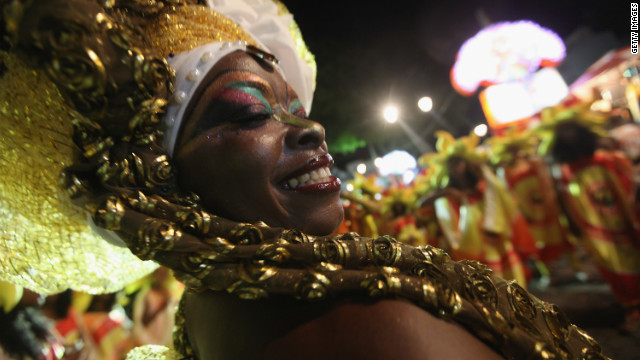
Showing posts with label African diaspora. Show all posts

Friday, October 26, 2012

From Samba to carnival: Brazil's thriving African culture


The cultural heritage stems from the estimated four million slaves that were brought to the country over a 300 tear period, at least four times as many as to the United States.
Brazil was the last country to abolish the slave trade in 1888. More than half of Brazilians now identify themselves as black or of mixed race, according to the latest census.
Rio de Janeiro   now has the most famous carnival in the world attracting an estimated 1.1 million visitors to the city this year and with 5.3 million people taking part in the street parties, according to the English language newspapers the Rio Times.
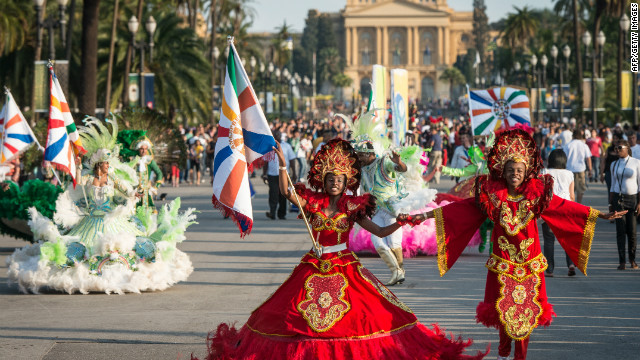

Samba dancers perform during a parade celebrating
Brazil's independence from Portugal 190 years ago, at Independence park in Sao Paulo.
Samba was developed in Brazil
 by the descendants of African slaves and draws on West African influences.
After the abolition of slavery, the rituals of the Catholic former colonialists and their former slaves merged to form the origins of modern carnival, according to the Rio Times. One explanation for the origins of carnival is that it began in a Catholic church, Our Lady of the Rosary, built by slaves in the 1700s whose masters wanted them to convert to Catholicism. "The black people that were part of this congregation, most of them came from Congo," said Joao Carlos Desales, a tour guide who took CNN around Rio de Janeiro. "So they were able to organize a celebration where they would choose a man and a woman, and they would be the king and queen of Congo. That celebration turned out to be the beginning of carnival celebrated in Brazil." Even many of Brazil's Catholic saints are said to have African heritage. St Benedict, whose name is remembered in Our Lady of the Rosary church, was a slave from North Africa, who promised to devote himself to Catholicism if he became a free man, Desales said. Brazil's patron saint, Our Lady of Aparecida, a black clay statue of the Virgin Mary, was -- according to some -- found by runaway slaves on their way to Quilombo, a community of runaway slaves. Quilombo communities continue across Brazil to this day. Luis Sacopa, president of the association of Quilombos, runs a restaurant with his 17 members of his family in a piece of jungle in what is now an expensive suburb of Rio de Janeiro. His grandparents found this piece of land after escaping slavery.
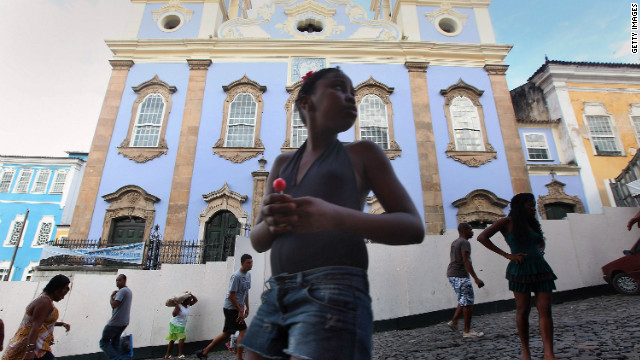

Salvador, in Bahia state, northeast Brazil, is the country's third largest city
 and was the country's first colonial capital. It has strong African roots and
 is the center for Afro-Brazilian culture
The family has fought a legal battle to hold on to its land against the threat of eviction, and now has official protection for their right to remain. "Thanks to god we have had success and we're still here at the end of our dispute," said Sacopa. "Thanks to god, the family has united, we're fighting and we're winning the fight against the elite in this expensive neighborhood of Rio de Janeiro." Sacopa said he was able to resist eviction with the help of his Orixas, gods of the Yoruba people of Southwest Nigeria, Benin and Togo. In Brazil, the religion is known as Candomble, and it has a large following in some Afro-Brazilian areas, particularly Salvador in Bahia state. Also on Inside Africa: Why Tanzanians believe in witchcraft Candomble was prohibited in Brazil up until the 1950s, but In Sacopa's restaurant he serves feijoada, a typical Brazilian dish originally created by slaves from their masters' leftovers.
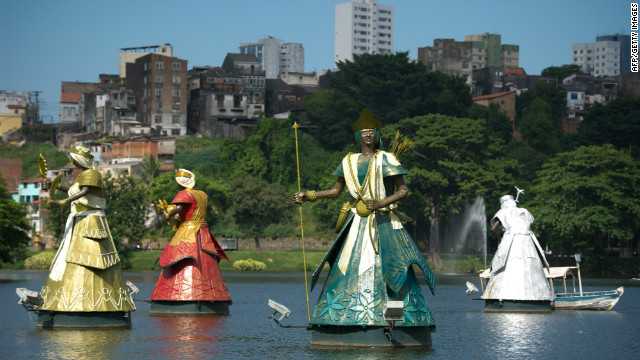
Orixas, deities of the Candomble religion, have been built in Salvador,
 northeastern Brazil. Salvador, which has a large Afro-Brazilian population,
 has many followers of Candomble.
 A new Historical Circuit of African Heritage opened in Rio de Janeiro in 2010 to help tourists and descendants of slaves reconnect with the past slavery. The project began after workers installing a new drainage system in the central districts of Saude and Gamboa discovered hundreds of personal objects belonging to African slaves, according to the Rio Times. Archaeologists established that this was the site of the 19th century slave trading complex, the Cais do Valongo, or Valongo Quays. Many of the discoveries are now on display in the Valongo Gardens, the newspaper reported. Another discovery of recent years is the remains of a squalid slave cemetery in the courtyard of a home in central Rio de Janeiro. Renaldo Tavares, an archeologist who has been studying the discovery, said: "These are human remains mixed in with the garbage from the city. It shows how society in the 19th century treated slaves. "Bones, pieces of ceramic, bits from construction, tiles, animal remains, bits of food, society threw all sorts of things in here. Slaves were considered garbage by society."


Ana de la Merced Guimaraes, the homeowner who discovered the bones in her courtyard, said: "When we started a reform in our house, we found all these bones. We thought it was a family grave, but there was so much we thought maybe it had been a serial killer. "But then we calmed down and talked about it and called a lawyer and the police. And he said don't worry, we aren't going to accuse you, it's probably something very old. "A neighbor told us, a long time ago, your street was a slave cemetery." Brazil's third city Salvador, in Bahia state, northeast Brazil, has some of the strongest links to Africa. Salvador was the first colonial capital of Brazil and its central district, Pelourinho, now a UNESCO world heritage site, was the New World's first slave market from 1553, according to UNESCO.
Enhanced by Zemanta

Sunday, June 17, 2012

The United States of HOODOO


The United States of Hoodoo / Trailer from Stoked Film, Germany on Vimeo.
A film by OLIVER HARDT
Written by DARIUS JAMES and OLIVER HARDT

Documentary, GER 2012, 100 minutes

A road trip to the spiritual sources of black American culture

The United States of Hoodoo is a film about how African based spirituality has informed America´s popular culture. The old African gods have taken on new forms since their arrival on North America's shores. Their spirit now manifests itself in turn-table wizardry, improvisational skills and mind-blowing collages, rituals and performances.

Featuring Darius James and Ishmael Reed, Nick Cave, Val Jeanty, Shantrelle P. Lewis, Danny Simmons, Kanene Holder, David "Goat" Carson, Hassan Sekou Allen, Sallie Ann Glassman

Theatrical release in Germany: July 2012
International release in autumn 2012

Website: http://hoodoo.stokedfilm.com
On Facebook: http://www.facebook.com/UnitedStatesOfHoodoo
Enhanced by Zemanta

Tuesday, January 31, 2012

ABAKUA .

Many of Trinidad’s masking traditions have direct links to Africa, and many African masking traditions were connected to secret societies, these societies came to the Caribbean with the enslaved Africans, and the traditions continued in secrecy throughout slavery, only to re emerge on the streets after emancipation.  Many his-storians will have you believe the enslaved Africans mimicked their French masters in the development of the carnival traditions, as if they had no culture or traditions of their own, but they did, not just in Trinidad but all over the Caribbean and Latin America.    
Take a look at the video below on Cuba’s Abakua traditions its origins are in the secret societies of West Africa and  is directly linked to the Cuban musical tradition of Rumba.


Abakua or Abakuá (various spellings are used) is an Afro-Cuban men's initiatory fraternity, or secret society, which originated from fraternal associations in the Cross River region of southeastern Nigeria and southwestern Cameroon. Known generally as Ekpe, Ngbe, or Ugbe among the multi-lingual groups in the region, these closed groups all used the leopard as a symbol of masculine prowess in war and political authority in their various communities. Ekpe and related organizations in the Calabar region were heavily invested in the slave trade emanating from the Bight of Biafra, though high-ranking officials were themselves ultimately captured and sold into slavery in Cuba, where the society re-emerged. The term Ñáñigo has also been used for the organization's members.

The creolized-Cuban term Abakuá is thought to refer to the Abakpa area in southeast Nigeria, where the society was active. The first such societies are thought to have arisen around the port of Havana in the early part of the 19th century, and this remains the main area of Abakuá implantation, especially the district of Guanabacoa in eastern Havana, and in Matanzas where Afro-Cuban culture is vibrant. While Abakuá eventually came to include members of European descent, this was not accomplished without conflict. Abakuá is sometimes regarded as evil malevolent sorcery.

Abakuá members derive their belief systems and traditional practices from the Igbo, Efik, Efut, Ibibio, spirts that lived in the ditey forest . Ekpe and synonymous terms like Egbo, Ngbe, and Ugbe were names of both a forest deity and a leopard related secret society. Robert Farris Thompson, an art historian and African Diaspora scholar, detailed the transformation and reemergence of this fraternal order in his classic Flash of the Spirit.

The rhythmic dance music of the Abakuá combined with Bantu traditions of the Congo contributed to one of Cuba's musical traditions, the rumba. The Calle family of Efo origin supposedly invented the guaguanco, a type of rumba.
Ireme is the Cuban term for the masked Abakuá dancer known as Idem or Ndem in the Cross River region. The masquerade dancer is carefully covered in a tight-fitting suit and hood, and dances with both a broom and a staff. The broom serves to cleanse faithful members of the fraternity, while the stick chastises both enemies and traitors to the Abakuá traditions. Thus, during initiation ceremonies it is called the Erí nBan nDó, while during mournings and wakes it is called AlanManguín Besuá.
Abacuá also describes a group of Afro-Cuban people of the carabalí as well as their style of music and their percussion instruments. Luciano "Chano" Pozo, conga drummer for Dizzy Gillespie, was a member of the Abakwa secret society.


Enhanced by Zemanta

Sunday, February 14, 2010

EOE marks Olokun Festival today


Egbe Onisin Eledumare will stage the annual Orisha Olokun Festival in Manzanilla today. The Olokun Festival is the Orisha Festival of the Ocean, in which man’s indispensable link and connectivity to the force of the ocean is celebrated. Olokun is the deity of the deep ocean, marshes and wetlands, and is protector of the African diaspora.
As an island people, Olokun is especially important to us. Divination has chosen The Bell Piece in Manzanilla as the site of this year’s festival. As usual it will be hosted by Egbe Onisin Eledumare. Egbe Onisin Eledumare is an African spiritual organisation functional in Ile-Iere—the Republic T&T—since 1971. The organisation has consistently been one of the most progressive voices for Orisha and African traditions in T&T.
Over the years, it has pioneered in the campaigning for the passage of the Orisha Marriage Act; and in holding two major Orisha and African Traditions Conferences in T&T. The organisation again broke ground when it fielded the first Orisha Carnival band and placed the first Orisha Queen of Carnival contestant on the Savannah stage. This year’s Olokun Festival is open to the public. There will be return-trip maxi-taxi transport and refreshments provided. The cost will be $100.
The celebration will begin with prayers at Egbe Onisin Eledumare, Simeon Road, at 5 am and there will be a main pick up point at the western entrance of PTSC in Port-of-Spain, close to the lighthouse, between 6.30 and 7.15 am. 
MORE INFO
The colour code is white, but persons can wear colours representing their shrines or Orisha. Items of offering include: boiled corn; yam balls; boiled black eyes peas with corn; popcorn; and, dry coconut.
For bookings and further information, call:
Oludari Sangode 727-3712;
Oloye Orawale Oranfe 380-9382; or
Rubadiri 797-0949.

Reblog this post [with Zemanta]

Share it.

Translate

Instagram

Instagram

ShareThis

Related Posts Plugin for WordPress, Blogger...

Facebook Badge

MAS REPUBLIC Headlines


This is MassassinnatioN

Global

QR

QR

Subscribe via email

Enter your email address:

Delivered by FeedBurner