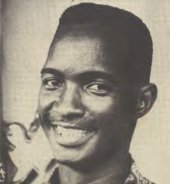
Showing posts with label George Bailey. Show all posts

Thursday, January 08, 2015

Memories - George Bailey Trinidad Carnival's Greatest Bandleader. A Film by Aldric G. Bailey

Take a look at this short film by Aldric Bailey that look s back at the life, works and achievements of the legendary mas man, band leader George Bailey and the legacy of that creative hub called Buller Street.

A Film by Aldric G. Bailey

"In 1959, Your Uncle George, the most famous of all the bandleaders, had produced Relics of Egypt... 
To me, Relics Of Egypt, was a continuation of Cecil B. De Mille's "The Ten Commandments"
and then he went on to win 3 more consecutively, that would be '59, '60, '61 and '62
But... In your Uncle's band... 
There was a... an individual who to me is the greatest individual in the History of Carnival, throughout The World... 
Because he is the first and only person ever, to produce a costume, that transcends all civilizations...
Which is really the concern of all men... 
Stipulated when the reknown English poet Keats, said, 'Beauty is truth, truth beauty,' — that is all Ye know on earth, and all ye need to know.”
John Keats - English Poet 1795 - 1821
Well, the individual, Terrence Evelyn, more popularly known as "Terry", produced a costume called, "Beauty in Perpetuity"
Obviously it would be difficult nay, nearly impossible, to produce a costume like that even every ten (10) years, but, to me, that is where we went, (I don't want to say "wrong") but we didn't try at least to keep up, with what that fella was saying... 
That the most important thing on the Earth is "Beauty" 
That is what, I think, we have lost...
Carnival needs, people like your Uncle, Evelyn, get Minshall, back into the arena...
Because no one I t hink, would like to go to Madrid, and go into The Bullring, and then you are told, "The best Bullfighter isn't facing the bulls"
Which is what we are really seeing here... People come to Trinidad and Minshall isn't producing a band and he is alive, people come here and Evelyn is not on the stage and he is alive...
[It] comes back again to what I had mentioned, what Uncle George say... "Tears of The Indies"... 

I, again, like I say, I'm on the outside looking in... and I was born in a time when, with respect, you know 15 Buller Street... I don't need to tell you, there used to be the empty lot behind... Several costumes, have gone over that wall to make their way up to the savannah to compete, King and Queen of the Bands...
I've lso heard stories of 15 Buller Street, being a Mecca of craftsmanship, Everything used to take place from screen printing to leather craft to papier mache to macrame to, you know, all of these crafts... 
It was like... ummm... A University of sorts, a repository of creative genius... 
That is where, when your Uncle decided to play The Realm of Fancy Bats and Clowns, it was from that, call it, potpourri, that Evelyn would choose to play "Beauty in Perpetuity"... so... you have to give...
Something went on in 15 Buller Street, it's there that Evelyn I understand, would sit down and be making these circles and circles...
So 15 Buller Street needs to be investigated and I don't mean 15 Buller Street alone, but all who came out of 15 Buller Street, like, the young boy, Stephen Derek, who is a, who is the main product of your father... So that... That's why I told you in the beginning Aldric, I really don't know..."

Sunday, September 23, 2012

Ronnie and Caro mas In the big league


Bandleader Ronnie Mc Intosh and the design team at Ronnie and Caro The Band are ready to take on Brian Mac Farlane and Associates for the George Bailey Band of The Year title in Carnival 2013. Mystery of the Cascadura is the theme of the portrayal. It’s the band’s sixth consecutive offering to the national festival. New rules laid down by the National Carnival Bands Association (NCBA) for the staging of the Parade of The Bands Competition in the run-up to Carnival 2012 bumped Ronnie and Caro from its prescribed and much enjoyed medium category, consequently placing the outfit in the big league. That meant the band with its portrayal The Mask Of…could not defend its title.
The costume Teal Bird ,
mirrors the beauty of the model that adorned it.
PHOTO: SEAN NERO
The team, however, remains unfazed.  
 
In just five years, the band won three Harold Saldenah Band of the Year (medium) titles; a proud feat. “We were basically forced into large category, but we would keep the number close to where they usually are. We would go further than 1,200-1,400. Even though we are large, we still would take it beyond that. “This is to ensure that service remains high. We want to keep it in a way that we know almost every masquerader.” Ronnie and Caro is a small unit, Mc Intosh said. “We are fully aware that we can’t manage 4,000 people. It makes no sense trying to do that because the level of service would drop. Masqueraders stay with us and new one join us because of the level of service that we offer.”
 
Consumer satisfaction is not the only aim of the bandleader. He is on a mission to revive lost traditions associated with T&T Carnival, even though it could limit his efforts at wealth creation. Proof of that is the band’s decision to move away from premiering its costumes in a party setting. For the past two years the band has opted to unveil its works of mas free to the public in an enlivening parade through Port-of-Spain, as witnessed back in August for the launch of with the launch of Mystery of the Cascadura. Asked why the band chose this option to premier its works of mas, Mc Intosh said it was a deliberate attempt to preserve a tradition of Carnival from the bygone era. Back then, Mc Intosh recalled, Raoul Garib, Stephen Lee Heung, Glenn Carvalho, costumes, as part of their contributions to T&T Carnival, would unveil their works of mas along Ariapita Avenue in Woodbrook and scores of culture enthusiasts would come out to witness these attractions. These launches were always free to the public.
 
Career Highlights


Accomplishments
Medium Band of the Year (Downtown) – 2012
4th Place Large Band of the Year (NCC) – 2012
Medium Band of the Year (NCC) – 2011
Medium Band of the Year (Downtown) – 2011
Medium Band of the Year (NCC) – 2010
Medium Band of the Year (Downtown) – 2010
Medium Band of the Year (NCC) – 2009
Best Designer (medium band) – 2009
2nd Place Band of the Day Medium – 2009
2nd Place Amoco Renegades – Medium 2009
Medium Band of the Year (NCC) – 2008
Medium Band of the Year (Piccadilly) – 2008
Most Colourful Band (Downtown) – 2008
2nd Place Band of the Day—Medium – 2008
2nd Place Amoco Renegades—Medium–2008

Enhanced by Zemanta

Thursday, September 13, 2012

TIME MACHINE: Trinidad and Tobago Carnival 1962.


1962 was a very eventful year in world history; there was a coup and a counter coup in the Dominican Republic, ‘The Incredible Hulk #1’ by Stan Lee and Jack Kerby made its debut.
 Rwanda, Burundi and Algeria, gained independence, Telstar relayed the first live trains Atlantic television signal, actress Marilyn Monroe died, Nelson Mandela was arrested in Howick, Spider man made his first appearance in Marvel Comics, James Merideth registered at the University of Mississippi, escorted by federal marshals, and the Soviet Union and the United States almost started WW3 and Armageddon during the Cuban missile crises.

1962 was also the year Trinidad and Tobago gained independence from Great Britain, and it is the year 1962 that Massassination will start its exploration of the past 50 years of the Trinidad and Tobago Carnival, in the ‘Time Machine’.
TIME MACHINE DESTINATION :1962

Examining the Carnivals of the past we can tell a lot about the society of the time, listening to the calypso’s of the period, especially social commentary we can form a picture of the society, and the issues that affected it during any given year. Looking at the mas bands at the time and the themes that were mostly historical, it is possible to ascertain that the question of identity racial, social, and global held precedence on the minds of bandleaders, mas men (carnival artist), and the masqueraders, (the wider population).  

Coat of Arms of the Federation.
 The Trinidad and Tobago carnival of 1962 was preceded by a period of great change in the region. The British West Indian colonies saw their first real attempt at political integration in 1958 with the idea of being a single independent state, ‘The West Indies Federation’, however dramatically collapse before their eyes in January1962. This collapse saw Islands like Jamaica and Trinidad then perusing individual independence for their people that was achieved later that year, and signified a new era of nationalism, self determination, and national identity.


Carnival 1962: March, 5th & 6th.
Queen of the Bands:

Esther Theodore: Queen of the bands 1962 .
 source:
The Carnivals of Trinidad and Tobago.
M Anthony
.
Dimanche Gras on the 4th of March 1962, and saw the crowning of  Esther Theodore, as the ‘Queen Of The Bands’, Theodore, who won the very first queen of the bands competition  in 1959, won again in 1962 portraying  ‘Cleopatra’ from Mack Copeland’s band ‘Glory of the Pharaohs’. A King of the bands completion did not take place till 1963.

The prize included a trip to the Waldorf Astoria in New York, a prize donated by Hilton Hotel as part of its promotion drive for the newly built Trinidad Hilton hotel.
Of that trip, Theodore said, “When I went on the trip I became an ambassador for Trinidad and Tobago in the field of Carnival. It was the first time Carnival was played in New York. I had to visit several places to introduce Carnival as a tourist attraction. One of the finest places I visited was St Nicholas Arena.”
The costume she wore on that occasion was described as a masterpiece. It was designed to fit a regal figure with a train 16 yards long and embroidered with symbols of Egyptian royalty and lotus flowers representing the “sun dance”.
There were also sacred emblems of the hawk, cobras and papyrus writings.” (Louis B Homer)


Calypso King:

The Calypso King competition saw the King of 1961 The Mighty Dougla; face the challenge of an already 2 time winner The Mighty Sparrow, The Mighty fighter, Lord Blakie, Nat Hepburn, Lord Cristo, Young Killer, Young Creole, and Lord Superior. (Michael Anthony pg 328)

When the battle was over The Mighty Sparrow won his third Calypso King title with two highly critical Calypsos, “Robbery with a V” where Sparrow accused the judges of robbing him of the title in 1961, giving it to Dougla, and the immortal classic, “Federation”, where sparrow expressed the frustration and disappointment of not just Trinbagonians but the Caribbean people, and angrily   chastised the Jamaicans for leaving and in effect destroying the Federation.

“If they know they didn’t want Federation,
And they know they didn’t want to unite as one,
Tell the doctor you not in favour,*
Don’t behave like a blasted traitor,
How the devil you could say you ain’t federating no more!”
(*Dr Eric Williams then leader of the PNM)


Road March:
Lord Blakie won his second ‘Road March’ title in 1962 with a witty Calypso that maximised the use of the 'double entendre' called Maria.

“Maria girl I love you so bad.
Maria if you leave me now will be hard
I don’t know what make me love so,
But she get me sweet!
What she give me to rub I eat.”


According to historian Michel Anthony this was the first time the road march was officially recognised in P.O.S, and Blakie won a $50 dollars in prize money. 2nd place went to Nelson Caton who sang Tattle Tale and 3rd went to Sparrow who sang Sparrow come back home.

Band of the Year:

George Bailey.
 By 1962 band leader George Bailey already established himself among the pantheon of ‘golden age’ bandleaders. Battling for the B.O.T.Y title in 62, were bandleaders  with presentations, such as, Edmund Hart’s Flag wavers of Siena, Harold Saldenha’s  Julius Caesar and the Conquest of Gaul, Geraldo Vieira’s Myths, Fables, and Legends and Jack Braithwaite’s Valhalla.

But carnival 1962 belonged to Bailey, his band Somewhere in New Guinea, won the band of the year award, the people’s choice award, Edmund Hart’s Flag wavers of Siena and Cito Velasquez’s, Natures Notebook, won second and third places in the competition.

“Although the bands following George Bailey were of great beauty none equalled or surpassed Somewhere in New Guinea...it was this band which won Band of the Year. This meant that George Bailey had won the title four years in a row.” (Michael Anthony pg385)

In San Fernando, it was Mac Copland’s Glory of the Pharaohs that beat the competition of Clemmie George’s Fabulous East, and Irwin Simmons Relics of the Bronze Age, to claim the southlands, B.O.T.Y title.

Pan:

While there was no Panorama in 62, there was a music festival that was won by the 'North Stars' that played "Voices of Spring" by Johann Strauss.
By the 31st of August 1962 Trinidad and Tobago was an independent nation, Britain’s Union Jack was lowered and the Red White and Black colours of Trinidad and Tobago were raised. Eric Williams was the first Prime Minister and the untold future was ready to reveal itself to an ambitious people.


Red with a white-edged black diagonal band from the upper hoist side to the lower fly side; the colours represent the elements of earth, water, and fire; black stands for the wealth of the land and the dedication of the people; white symbolizes the sea surrounding the islands, the purity of the country's aspirations, and equality; red symbolizes the warmth and energy of the sun, the vitality of the land, and the courage and friendliness of its people.
(source: C.I.A)


Enhanced by Zemanta

Friday, October 22, 2010

The best and the worst in culture: PETER RAY BLOOD

LEFT: Sherry Ann Guy as The Hummingbird, a Peter Minshall creation.
RIGHT: Master masman Peter Minshall.
“Text blindness” is an affliction that renders a reader blind to what is actually published in black and white. I am forced to make this pronouncement based on the number of responses I’ve had since my last edition of Pulse last Friday. While many called to congratulate me on “my list” of “The best and the worst in culture,” others called to disagree with my supposedly list, and to make suggestions.
Ironically, not one caller, and the callers included renowned scholars and academics, as well as celebrated musicians, composers, arrangers and artistes, realised that the first paragraph of my short introduction boldly stated that the “list of the Best (and Worst) Ever Musicians, Calypsonians, Bandleaders, Entertainers, etc,” was compiled by cultural researcher Dr Kwame Nantambu, with assistance from Dr Hollis “Chalkdust” Liverpool. Today I publish the remainder of Dr Nantambu’s list, as well as a few of my favourites as well.
Dr Kwame Nantambu’s list:

Friday, February 12, 2010

Mas Legend Alvin Bailey dies at 71.

Once again in the growing excitement of Carnival the culture has lost another great warrior, I don’t know how this skipped the radar, but Trinidad Carnival legend Alvin Bailey passed away on the last week, Alvin was the brother of Albert Bailey and the late legend George Bailey.
Thank you for the memories Alvin Bailey.
May he rest in peace.


Reblog this post [with Zemanta]

Sunday, January 31, 2010

Making mas in Woodbrook

Bois Cano bush and breadfruit leaves


Every Carnival season, from early January, the Bailey’s house on quiet Buller Street, Woodbrook, is transformed into a mas camp...literally. Red, blue, gold and yellow pieces of costumes fill almost every space in the house and yard of the house that mas veteran, Albert Bailey shares with his daughter, her husband, their two children and a grandchild. The Baileys are bringing out a children’s band, Dancers of Africa, and are helping make costumes for Stephen Derek’s band, Call Dat George. The only place that is left almost untouched is the kitchen, where Bailey’s daughter, Lee Ann, a caterer, prepares food for the mas camp workers.
“I sleep anywhere, on the floor, the recliner,” Lee Ann said. Lee Ann, who decorates the costumes, also plays queen for Derek’s band. The one bedroom where a bed was left in it is shared by Bailey and his grandaughters, Giselle and Alendra. One of the workers stays fulltime in the Bailey’s mas camp/house for the duration of the Carnival season. Huge parts of costumes already completed, rest against the walls of the bedrooms while the living room looks like an incomplete Carnival band. The excitement and happiness the season brings for the Baileys were evident when the Sunday Guardian visited last Tuesday.
Keeping Bailey tradition alive
Bailey, brother of mas icon, George Bailey, who died in 1972 at age 36, said he was working with Derek, his “student,” to bring out a band which pays tribute to his deceased brother. His camp, like Derek’s, is one of the few in Woodbrook, described as “the mecca of mas making,” where costumes are actually made and not imported. It was from the Bailey brothers that Derek learnt the art of wirebending. The frame of a big costume, already skillfully bent by Bailey, stood in one corner of the front yard on wheels, waiting to be completed. Only a small group worked on producing the costumes for Call Dat George and the eight-section children’s band, which has ten separate characters.
“I have a very powerful group of four,” Bailey said, sitting among pieces of mas in his porch. “I don’t need more. Everybody knows what to do and gets to work.” Alendra, the designer of the children’s band, added: “We started working on January 7, and in three weeks finished all this.” Alendra’s passion is to continue the Bailey tradition of mas making. “Forty-three years mas making has been going on in this house,” she said proudly. “Dr Eric Williams and Prime Minister Patrick Manning visited here.” Boxes of ostrich plumes and pheasant feathers lay on a table in a shed at the side of the house, where Mervyn Johnson, 75, glued shenney braids to what will be the arm of a chair in a large costume. Johnson, of Brooklyn, has been coming to the Bailey’s camp for “forty-something years” to make mas. While Bailey uses bois cano bush and breadfruit and palm leaves, he buys the ostrich and pheasant feathers from abroad because they are not available locally, he said.
In the porch, Debra Joseph glued sequins onto a jacket for a costume.
“I grew up in the Bailey camp. I started at 14 and now I am 51, and I am still going with them.” Joseph, a grandmother and Finance Ministry worker, said she takes her vacation every year to work in Bailey’s camp. “I take up residence here for the season,” she said. Odette Emmanuel and Giselle Campbell, taking a lunch break, were eating breadfruit oildown and fish in the living room. Campbell had been putting blue braids onto a shield, and Emmanuel was putting blue lame on a fan. Emmanuel, a grandmother, of La Horquetta, and part-time employee, works most days in Bailey’s mas camp until 4 pm. “Thirty-two years I around,” she said.
Praying hard
Bailey, 73, who began playing mas at age ten in 1946 with a Woodbrook band called “Hell’s A Popping,” has been bringing out winning bands for the past 37 years. He had been with Peter Minshall before but “had to get out because it was taking over,” he said. Bailey describes mas today as “Carnival in the flesh.” He said while local mas was veering more to “the flesh,” Brazil, which was famous for its topless dancers, is going back to costumes. He refutes the notion, however, that Carnival comes from the devil. “Something as beautiful as Carnival has to come from the good side,” he said. “In fact, I pray very hard for the success of my band.”
Trinidad Guardian
Reblog this post [with Zemanta]

Sunday, January 24, 2010

From calabash to cane arrows


In the yard of a small, ageing, colonial-styled house on Kitchener Street in Woodbrook, veteran wire bender Stephen Derek and his helpers worked quietly on making what they call “true mas.” Behind jalousied windows inside the yellow house came the whirring of a sewing machine, as Denise Duncan stitched, surrounded by brightly-coloured costume pieces. Large, skeletal wire frames, already bent by Derek, stood in the yard, waiting to be transformed into elaborate costumes. This is the mas camp of D Midas T&T, led by Derek, a protégé of late mas icon George Bailey.
To calypso music, Derek and his helpers, bent wire, covered frames and glued gold sequins. “Everything here is hand-made,” said Derek, two pencils behind an ear, a measuring tape around his neck, a roll of wire at his feet, and pliers and a utility knife on the table nearby. The band’s 1,000 costumes are made right here in T&T, and not imported, as is usually the practice with the big bands, committee member, Tony Alleng says. “Ninety-five per cent of the big bands, who have corporate sponsors, purchase their costumes from outside. “Wire-bending and making mas is a dying tradition in T&T. Big bands who want help with their few local pieces pay Derek to bend wire for them.

Worldwide demand
While it’s a dying art here, Derek’s wire-bending services are in demand in Carnivals all over the world, from Miami to South Africa, he said. Alleng claimed that foreign mass-produced costumes are made using child labour in countries like China and Bangladesh. Derek said two tourists from Seattle walked into the mas camp last Monday night, and said it was exactly what they were looking for in T&T’s Carnival. “They said it was real. Most of the big bands use aluminium and lots of fabric and air-brush it, Minshall-style. That’s it.” Is the mas getting modern?
“They getting lazy,” Derek, 58, of Diego Martin, said. “The craftsmanship, the creativity of the people...they have taken that away from Carnival. “What’s there is somebody’s else mas dumped on us. They are eliminating the people from Carnival.” He predicted: “There will come a time in the not-too-distant future when the word bandleader will become extinct. They will have CEOs.” Godfrey “Box” Marchand, 69, bent wire frames for the children’s band, a bag of tools near him last Tuesday. Fellow wire-bender and close friend of Derek, “Box” comes from Brooklyn, New York, every year to work in D Midas mas camp. “Since age 12, I’ve been doing this,” he said. Ronald Mills, 71, sat near his fancy sailor costume, while Vijay Goorasingh covered the frame with metallic lamé.
Mills, of New Jersey, is playing king for the band, The Boss. D Midas was hired to make the costume. “I’ve been playing mas all my life and I come every Carnival,” he said. In a corner of the camp, Lucinda Patterson, 48, painstakingly glued gold sequins onto part of a costume. Patterson, of Laventille, a mom, is a volunteer, and said she had to glue on hundreds of sequins. About 30 people work from morning until 10 pm in D Midas’ camp, most of them volunteers. They all work under a poster on the wall that says “Costumes designed and produced in T&T.”


Fantasy mas
Derek said the Samaroos, who owns a carnival business, had been placing the sign in “local” mas camps across the country. D Midas, as is its custom, uses a lot of natural materials. “We’re using the calabash, for instance. We cut, clean and paint it. “Beads are not new, but when I was young, we made our own beads from natural products.” The band has been collecting whatever cane arrows they could salvage from abandoned sugar cane fields all over T&T, as well. Derek, who, as a little boy worked in Bailey’s Buller Street, Woodbrook mas camp, is celebrating the 40th anniversary of Bailey’s death in his production, Call Dat George. The 14 sections of the medium band will feature each of Bailey’s years in mas, from 1956 to 1970.
“It was from Bailey that Derek learnt the art of wire-bending,” Alleng said. “It was Bailey who changed the look of Carnival. He was the first to bring out a fantasy band.” A mas designer’s fantasy was like an artist’s abstract art, Alleng explained. Derek’s “Bible,” an album of old photographs of Bailey’s mas, lay on the table near his pliers. D Midas, which also produces a children’s band with Zebapique Mas Camp, has won several titles, including last year Junior Carnival King, played by Yanick Holdip.

Trinidad Guardian

Monday, November 09, 2009

TIME MACHINE: Trinidad Carnival 1959.


The Ministry of Tourism has posted some Trinidad and Tobago Carnival video clips from the Carnival of 1959 on you tube.
On the videos you can see great Masters of the Art form such as Harold Saldenha and George Bailey in their prime, and their epic Carnival presentations crossing the Queens Park Savannah stage to become subjects of legend in the colourful history of  Trinidad an Tobago’s Carnival.
And for those of you who wish to know a little more about Trinidad Carnival 1959, here are some more facts.          


Carnival Monday and Tuesday of 1959 was on the 9th and 10th of February, the Road March of that year was ‘Run the Gunslingers’ by the Mighty Caruso, The Mighty Striker won the Calypso King competition for the second year in a row with the Calypso’s ‘Ban the hula hoop’, and ‘Comparison between West Indians in England and foreigners in Trinidad’.
The first Queen of the bands title was won by Esther Theodore “who portrayed the Empress Alexandra, wife of Nicholas II of Russia. She was from the San Fernando band Festival of Moscow”. (M. Anthony 1989, p274).
A lot of people debate if the period between the mid 1950’s and the early 1980’s can be considered the Golden Age of Carnival, but consider the names of the legendary Mas Men and bandleaders that competed against each other during this period and their presentations.
Spectators of 1959 would have witnessed a spectacle that composed of bands such as these...All Stars with over 1000 playing United States Naval Forces, Bobby Ammon’s ‘Conquistadores’ “ a band depicting the meeting between Spanish forces and Montezuma II just before the fall of Mexico at Christmas in 1521” (M. Anthony 1989, p276).
Irving Mc Williams ‘Feast of Belshazzar’, Neville Aming, ‘The Reign of the Ming’s,  Harold Saldenha’s ‘The Cree Indians of Canada’, and the band that won Band of the year, George Bailey’s ‘Relics of Egypt’. Bailey’s band also won the first people’s choice title. The band was made up of 350 members and divided into 15 sections portraying 36 dynasties of Ancient Egypt.
Saldenha’s band was made up of 550 members and 26 sections, the Irving Mc Williams band Feast of Belshazzar was made up of 502 members.
Carnival 1959 also saw an infamous Clash on the streets of POS between Desperadoes and San Juan All Stars leaving around 30 people injured, San Juan’s theme that year was ‘War Cry’, the Desperadoes presentation of Fruits and Flowers was destroyed in the battle. (M. Anthony 1989, p278).
 
One thing about looking at these videos there is no doubt that there is an evident decrease in the creative
efforts put into Mas since the late 1950’s , however one thing cannot be denied, then like now a fantastic time is always had by all.

Enhanced by Zemanta

Share it.

Translate

Instagram

Instagram

ShareThis

Related Posts Plugin for WordPress, Blogger...

Facebook Badge

MAS REPUBLIC Headlines


This is MassassinnatioN

Global

QR

QR

Subscribe via email

Enter your email address:

Delivered by FeedBurner